If you are exploring modern medical solutions for weight management, you have likely encountered the term “peptide”. While the science behind these treatments is rapidly advancing, navigating the landscape of new medications can feel overwhelming. If you are wondering about the best peptides for weight loss, how they function, and whether they might be right for you, this guide will provide a clear, evidence-based overview.
Understanding Peptides and Fat Metabolism

At their core, peptides are chemical compounds, often short chains of amino acids, that act as crucial signaling molecules in the body. You can think of them as messengers that instruct your cells and organs on how to operate.
In the context of metabolic health, certain peptides interact with your endocrine system to regulate the hormones responsible for appetite, insulin sensitivity, and how your body stores or burns fat. By mimicking naturally occurring hormones, targeted peptide therapies can help shift your body’s physiological state from storing fat to actively metabolizing it.
A Patient’s Journey to Exploring Peptides
Consider Sarah, a 45-year-old marketing executive who had always maintained an active routine but recently noticed an accumulation of stubborn abdominal fat that wouldn’t budge despite strict dieting. Frustrated by the lack of results and concerned about her long-term metabolic resilience, she began reading about peptides online.
Like many people, she was quickly overwhelmed by the conflicting information and complex medical jargon. She needed a reliable, evidence-based roadmap to understand which options were both safe and effective before making any medical decisions.
The Best Peptides for Weight Loss: Main Categories

When evaluating the best peptides for weight loss, it is vital to distinguish between clinically proven medical therapies and unregulated compounds. Here is a breakdown of the primary categories currently shaping the landscape of obesity management.
1. GLP-1 Receptor Agonists (and Dual Agonists)
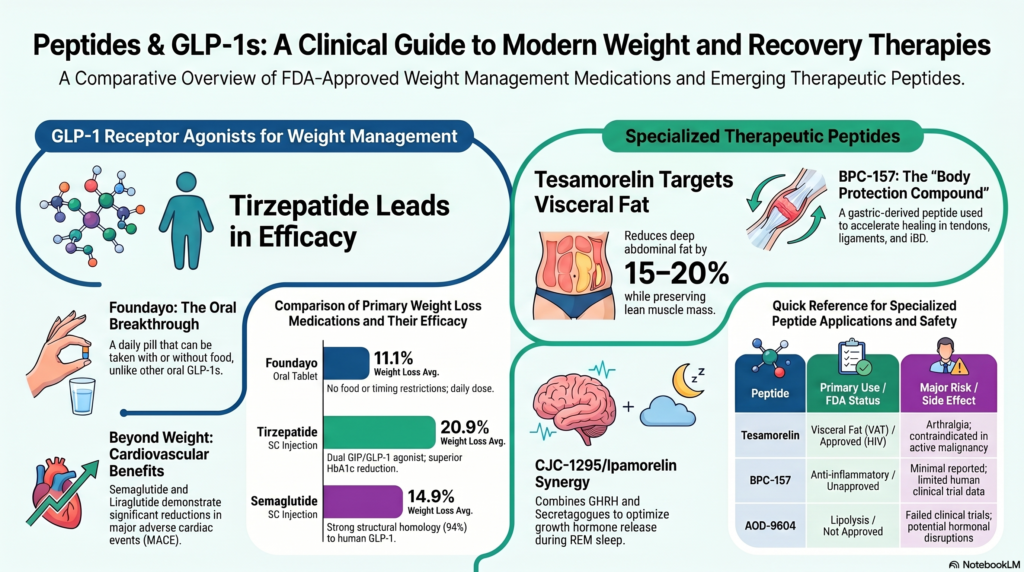
Glucagon-like peptide-1 (GLP-1) receptor agonists are currently the most prominent and clinically validated class of weight-loss peptides. This category includes well-known injectable medications like semaglutide and liraglutide, as well as newer dual-agonists like tirzepatide, which target both GLP-1 and GIP receptors. Recently, oral options like Foundayo (orforglipron) have also emerged, offering the convenience of a daily pill without food restrictions.
- How they work: These peptides mimic the natural incretin hormones secreted in your gut after you eat. Mechanistically, they delay gastric emptying, meaning food stays in your stomach longer and you feel full for extended periods. Furthermore, they communicate directly with the appetite centers in the brain to reduce cravings and food intake, while also stimulating insulin secretion to keep blood sugar stable.
2. Growth Hormone Secretagogues

Instead of supplying the body with synthetic human growth hormone—which can carry safety risks and unpredictable side effects—growth hormone secretagogues prompt your pituitary gland to release its own natural growth hormone in a healthy, physiological pattern.
- CJC-1295 and Ipamorelin: Often prescribed together, these two peptides act on different families of receptors to maximize the release of natural growth hormone. This combination improves the body’s ability to burn fat, increases muscle mass, and aids in recovery from workouts.
- Tesamorelin: This peptide is a synthetic analogue of growth hormone-releasing hormone (GHRH). Clinical trials have shown that tesamorelin selectively targets and reduces deep, metabolically active visceral adipose tissue (visceral fat) by 15-20% without significantly affecting the fat just under the skin.
3. AOD-9604
AOD-9604 is a synthetic fragment originally developed to mimic the fat-reducing effects of human growth hormone without triggering its growth-promoting properties.
- How it works: In preliminary research, it was thought to interact with the body’s beta-adrenergic pathway to increase lipolytic activity—the breakdown of fat tissue—and increase energy expenditure.
- Note on safety: While frequently discussed online, AOD-9604 is not recommended by medical guidelines and has not received FDA approval for weight loss or any other indication. Its safety and efficacy in humans remain largely unproven, making it an unreliable and potentially risky option compared to clinically validated therapies.
Comparing the Mechanisms: A Quick Overview
To help you understand the landscape, here is a light comparison of how these different peptides approach fat loss:
| Peptide Category | Examples | Primary Mechanism |
| GLP-1 & Dual Agonists | Semaglutide, Tirzepatide, Orforglipron | Reduces appetite via the brain, delays gastric emptying, and enhances glucose-dependent insulin secretion. |
| Growth Hormone Secretagogues | Tesamorelin, CJC-1295 / Ipamorelin | Stimulates the natural release of growth hormone, targets stubborn visceral fat, and supports muscle preservation. |
| Fat-Burning Fragments | AOD-9604 | Designed to increase fat breakdown (lipolysis); however, it lacks rigorous clinical backing and FDA approval. |
Who Might Be a Candidate?
The ideal candidate for peptide therapy depends heavily on the specific medication.
- GLP-1 therapies are typically prescribed for adults with obesity, or individuals with overweight who also suffer from weight-related medical conditions such as high blood pressure or sleep apnea.
- Tesamorelin is FDA-approved specifically for HIV-associated lipodystrophy (abnormal abdominal fat accumulation), though physicians may consider it off-label for patients seeking to address severe visceral fat and metabolic resistance.
- Ultimately, the most successful candidates are those who use these therapies as a powerful adjunct to foundational lifestyle modifications, including a reduced-calorie diet and increased physical activity.
Conclusion and Next Steps
Finding the best peptides for weight loss requires a personalized approach that prioritizes clinical evidence, safety, and your unique metabolic profile. Whether you are a candidate for appetite-regulating GLP-1s or visceral-fat-targeting secretagogues, these therapies represent a significant leap forward in the science of healthy weight management.
If you are ready to stop guessing and start treating the root cause of your metabolic resistance, we are here to help. Contact us today to book an appointment with our medical team and discover which treatment plan is right for you.